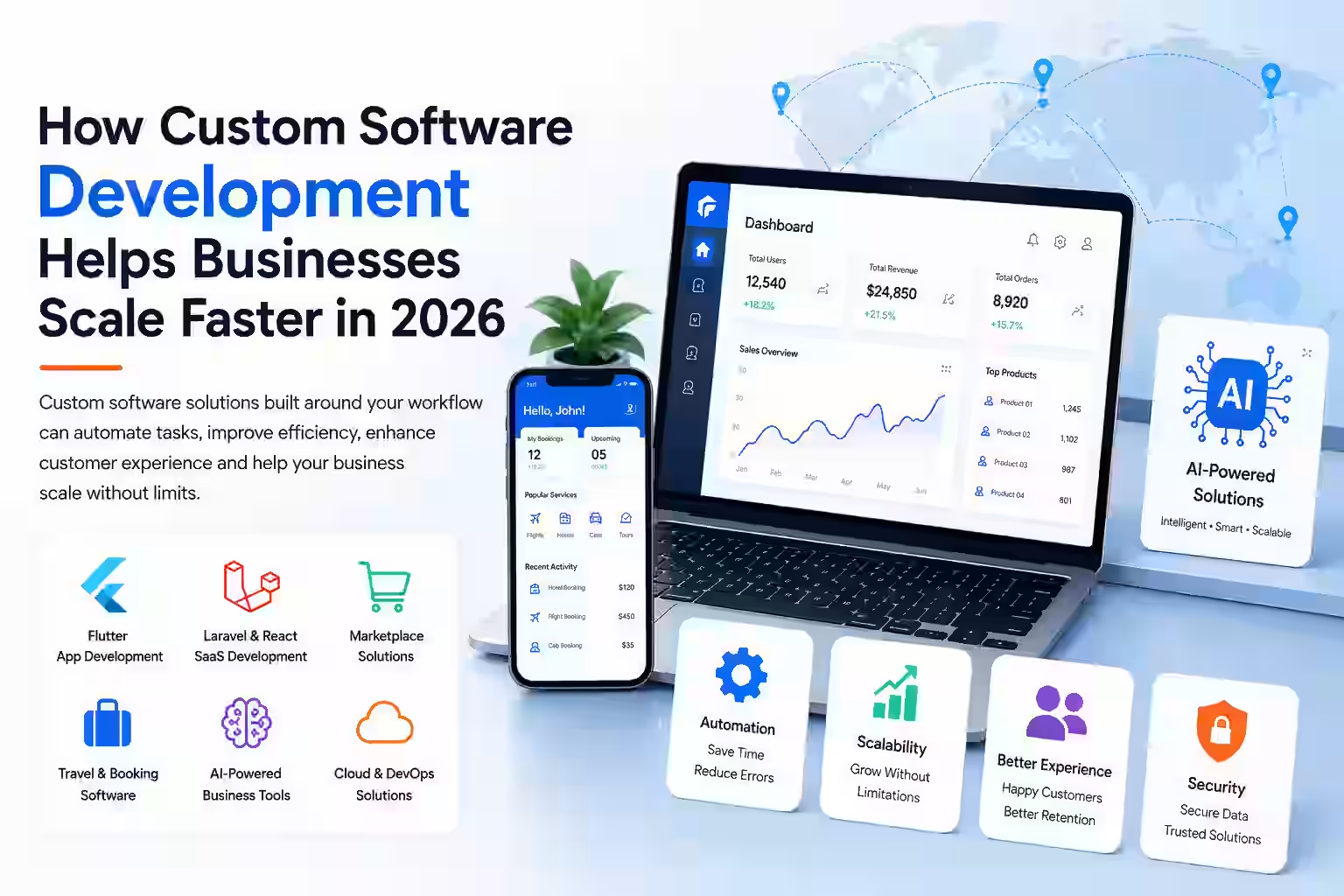

Businesses today are no longer competing only on products and pricing. Technology, automation, customer experience, and operational efficiency have become major factors in determining how quickly a company can grow.
Off-the-shelf software can be useful when starting out, but as a business grows, its processes become more complex. Teams may need custom dashboards, automated workflows, mobile applications, integrations, payment systems, customer portals, or industry-specific platforms.
This is where custom software development becomes valuable.
What Is Custom Software Development?
Custom software development means building a software solution specifically around the requirements of a particular business.
Instead of changing your business processes to fit an existing application, custom software allows the technology to fit your workflow.
A custom solution can include:
- Web applications
- Mobile applications
- SaaS platforms
- Booking and reservation systems
- Multi-vendor marketplaces
- CRM and ERP systems
- Payment integrations
- AI-powered business tools
- Automated reporting systems
- Admin and management dashboards
- API integrations
The objective is not simply to build software. The objective is to solve a business problem with technology.
Why Businesses Are Moving Toward Custom Software
1. Software Built Around Your Workflow
Every business operates differently.
A travel company may need itinerary management, multi-currency pricing, hotel and transport management, payment schedules, and automated customer notifications.
A marketplace may require vendor onboarding, commissions, payouts, inventory management, and order tracking.
A generic application may provide some of these features, but custom development allows every component to be designed around the company's actual workflow.
2. Better Automation
Manual processes consume time and increase the possibility of human errors.
Custom software can automate repetitive tasks such as:
- Customer notifications
- Invoice generation
- Payment reminders
- Report generation
- Order processing
- Lead assignment
- Data synchronization
- Email campaigns
- Booking confirmations
Automation allows employees to spend more time on tasks that actually require human decision-making.
3. Easier Integration With Other Systems
Modern businesses rarely use a single software system.
A company may need to connect its application with:
- Payment gateways
- Email services
- SMS providers
- Google Maps
- Accounting software
- CRM systems
- Cloud storage
- Third-party APIs
- AI services
Custom software can be designed with APIs and integrations from the beginning, creating a connected technology ecosystem instead of isolated tools.
Custom Software Can Improve Customer Experience
Customers expect fast and convenient digital experiences.
A well-designed application can allow customers to:
- Create an account
- Search for products or services
- Compare available options
- Make a booking or purchase
- Complete online payment
- Receive notifications
- Track their order or booking
- Access invoices and documents
- Contact support
When these processes are connected in one platform, customers don't have to move between multiple systems.
Mobile Applications Are Becoming Essential
For many businesses, a mobile application can become an important customer channel.
Technologies such as Flutter allow companies to develop applications for both Android and iOS from a shared codebase.
A modern Flutter application can include:
- Push notifications
- Online payments
- Location services
- Real-time tracking
- Offline functionality
- Third-party API integrations
- Secure authentication
- Custom dashboards
This can significantly reduce development and maintenance complexity compared with maintaining completely separate mobile applications.
SaaS Platforms Can Create Recurring Revenue
Custom development is also useful for businesses building software products of their own.
A SaaS platform can provide customers with subscription-based access to software while the business manages the underlying infrastructure.
A scalable SaaS architecture can include:
- Multi-tenant architecture
- Subscription management
- Role-based permissions
- Admin dashboards
- API systems
- Automated billing
- Analytics
- Notifications
- Background processing
This approach allows businesses to turn software into a recurring-revenue product.
AI Is Changing Custom Software Development
Artificial intelligence is becoming another important layer of modern business applications.
Instead of creating AI features simply because they are trending, businesses should identify processes where AI can create measurable value.
Examples include:
- AI customer support
- Document processing
- Intelligent search
- Recommendation engines
- Automated data extraction
- Content generation
- Business analytics
- Workflow automation
- AI-powered internal assistants
The combination of traditional software and AI can create applications that are considerably more useful than either technology alone.
Why Scalability Should Be Considered From Day One
One common mistake is building software only for today's requirements.
A business that starts with 100 users may eventually have 10,000 or 100,000 users.
The architecture therefore needs to consider:
- Database performance
- API scalability
- Cloud infrastructure
- Caching
- Background jobs
- Security
- Monitoring
- Automated deployments
- Data backups
A scalable architecture makes it easier to add new features and support increasing traffic without rebuilding the entire platform.
Security Cannot Be an Afterthought
As software becomes responsible for more business operations, security becomes increasingly important.
Custom applications should consider:
- Secure authentication
- Role-based access control
- Data encryption
- API security
- Input validation
- Secure payment processing
- Database security
- Regular backups
- Monitoring and logging
- Security updates
Security should be considered during architecture and development rather than added after the product has already been launched.
How Fevoff Industries Helps Businesses Build Digital Products
At Fevoff Industries, we build technology solutions around specific business requirements rather than forcing businesses into generic software.
Our development capabilities include:
- Flutter App Development
- Laravel & React SaaS Development
- Travel & Booking Software
- Marketplace & Multi-Vendor Platforms
- AI-Powered Business Tools
- REST API Development
- Cloud & DevOps
- Ongoing Maintenance & Support
Our approach starts with understanding the business problem, followed by architecture, development, testing, deployment, and long-term support.
We also work with businesses across Europe, the United States, UAE, and Malaysia through a remote-first development model.
Final Thoughts
Custom software is not simply about having a unique application.
It is about creating technology that makes your business faster, more efficient, easier to manage, and easier to scale.
Whether you are launching a startup, replacing manual processes, creating a SaaS product, building a marketplace, or developing an AI-powered platform, the right technology architecture can become a significant competitive advantage.
Have a software idea or an existing system that needs improvement?
Talk to Fevoff Industries and turn your business requirements into a scalable digital product.
Build smarter. Automate better. Scale faster.